So, you want to create DJ playlists that get the party jumping and keep people on the dance floor all night long? It's more than just throwing a bunch of popular songs together. Professional DJs know the secrets to crafting a perfect musical journey. Ready to up your DJ game and learn how to build killer song lists? We’re diving deep into the surprising playlist tips that the pros swear by. These aren’t your run-of-the-mill suggestions – these are tried and true techniques to elevate your sets and leave your audience wanting more. Get ready to transform your approach to DJing and create unforgettable experiences!
🎯 Key Takeaways
- Learn how to analyze your audience to tailor your music selection effectively.
- Discover the importance of music key compatibility for seamless transitions.
- Understand the art of energy flow by building and releasing tension in your sets.
- Master the use of intro and outro techniques to create smooth mixes.
- Explore advanced playlist curation strategies for various event types.
Analyze Your Audience Like a Pro
Before you even think about picking a single track, you need to know who you're playing for. What's the age range? What kind of events do they usually attend? What genres are popular in your area? This isn't guesswork – it's market research for your music.
Understanding your audience is absolutely crucial to building a successful set. You wouldn't play heavy metal at a wedding, would you? It's about reading the room and anticipating their tastes.
Here's how to get started:
- Scout the venue: Visit the location beforehand to get a feel for the typical crowd.
- Social media stalking (the ethical kind): Check out the venue's or event's social media to see who's attending and what kind of music they share.
- Talk to the organizers: Get insights from the event planners about the demographics and musical preferences of the attendees.
Once you have a solid understanding of your audience, you can start tailoring your playlist to their specific tastes. Are they a crowd that loves sing-alongs? Do they prefer high-energy dance tracks, or are they more into chill vibes? Let their preferences guide your music selection.
For example, if you're playing at a college bar, you might focus on current pop hits, hip-hop anthems, and electronic dance music. If you're DJing a corporate event, you might lean towards classic rock, funk, and soul.
💡 Pro Tip: Don't be afraid to ask for feedback during your set. A quick check-in with the crowd can help you gauge their reaction and adjust your playlist accordingly.
The Secret Power of Key Compatibility
Most DJs focus on BPM (beats per minute) matching, but key compatibility is where the real magic happens. Mixing songs in compatible keys creates a harmonic blend that is much more pleasing to the ear. It makes your transitions sound effortless and professional, preventing that jarring feeling when two songs clash.
Think of it like this: you wouldn't sing two melodies at the same time if they were completely dissonant, right? The same principle applies to mixing music.
Several software programs can help you analyze the key of your tracks. Mixed in Key is a popular option, but there are also free alternatives available. Once you know the key of each song, you can start building your playlist with harmonic mixing in mind.
Here are some key compatibility guidelines:
- Same Key: The easiest and most common transition.
- Relative Minor/Major: A seamless transition between a major key and its relative minor (e.g., C major to A minor).
- Perfect Fourth/Fifth: Moving up or down a perfect fourth or fifth on the Circle of Fifths provides a pleasing harmonic change.
Here's an example: you could smoothly transition from "Don't Start Now" by Dua Lipa (B minor) to "Blinding Lights" by The Weeknd (A major) because they are relative minor/major keys. The change is subtle but creates a richer, more satisfying listening experience.
Crafting the Perfect Energy Flow
A great DJ set isn't just a random collection of songs; it's a carefully crafted journey that takes the audience on an emotional rollercoaster. Think of it as building a story, with a clear beginning, middle, and end.
The key is to control the energy flow. Start with some warm-up tracks to get people moving, gradually build the intensity with high-energy bangers, and then bring it back down with some chill-out tunes towards the end.
Consider this:
Here's a sample energy flow for a 2-hour set:
- Warm-up (30 mins): Start with mid-tempo tracks (100-110 BPM) that have a groove but aren't too intense.
- Build-up (45 mins): Gradually increase the BPM (110-125 BPM) and introduce more energetic tracks with recognizable hooks and sing-along potential.
- Peak (30 mins): Unleash your biggest bangers (125-135 BPM) – the songs that everyone knows and loves. This is where you want to create a frenzy on the dance floor.
- Cool-down (15 mins): Gradually reduce the BPM (110-120 BPM) and transition to more mellow tracks with a chill vibe.
💡 Pro Tip: Pay attention to the crowd's reaction and adjust your energy flow accordingly. If they're still going strong during the cool-down, you can throw in one last banger to keep the party alive.
Mastering Intro and Outro Techniques
Seamless transitions are the hallmark of a professional DJ. And the secret to smooth mixes lies in mastering intro and outro techniques. A good intro allows you to seamlessly blend one song into another, while a good outro provides a clean exit and sets the stage for the next track.
Many songs have extended intros and outros that are perfect for mixing. These sections often feature instrumental passages, drum fills, or ambient sounds that allow you to blend the tracks together without any jarring vocals or melodies.
Here are some common intro/outro techniques:
- Beatmatching: Align the tempos of the two songs to create a smooth transition.
- EQing: Use the equalizer to blend the frequencies of the two songs, preventing them from clashing.
- Fading: Gradually fade out the first song while fading in the second.
- Cutting: Abruptly cut from one song to another, creating a dramatic effect.
For example, let's say you want to transition from "Good as Hell" by Lizzo to "Juice" by Lizzo. Both songs have strong beats and recognizable vocals, but you can use the instrumental intro of "Juice" to create a smooth transition. Start by beatmatching the two songs, then gradually fade out "Good as Hell" while fading in "Juice."
Crafting Theme-Specific Playlists
Sometimes, you're not just playing music – you're setting a mood. Theme parties, holiday events, and even specific genres require a more curated approach to playlist creation. Tailoring your music to the specific theme or event will create a more immersive and engaging experience for your audience.
Here are some examples of theme-specific playlists:
- 80s Night: Focus on iconic 80s anthems from artists like Michael Jackson, Madonna, Prince, and Bon Jovi.
- 90s Hip-Hop: Feature classic hip-hop tracks from artists like Notorious B.I.G., Tupac, Snoop Dogg, and A Tribe Called Quest.
- Halloween Party: Include spooky and atmospheric tracks with a Halloween theme, such as "Thriller" by Michael Jackson, "Monster Mash" by Bobby Pickett, and "This Is Halloween" from "The Nightmare Before Christmas."
- Tropical Beach Party: Play reggae, Latin, and Caribbean-inspired music that evokes the feeling of being on a tropical beach.
For a romantic theme, here are some song suggestions:
- "At Last" by Etta James — Timeless classic for slow dances
- "Thinking Out Loud" by Ed Sheeran — Modern romantic ballad
- "All of Me" by John Legend — Soulful and heartfelt declaration of love
- "Can't Help Falling in Love" by Elvis Presley — Iconic love song
Curating a "Must-Have" Dance Playlist
Every DJ needs a reliable arsenal of dance floor anthems that are guaranteed to get people moving. These are the songs that transcend genres and generations, the ones that everyone knows and loves. Think of it as your secret weapon, your go-to playlist for when you need to inject some energy into the crowd.
Can't-Miss Tracks
- "September" by Earth, Wind & Fire — Timeless funk anthem that's impossible not to dance to.
- "Uptown Funk" by Mark Ronson ft. Bruno Mars — Modern funk classic that always gets the party started.
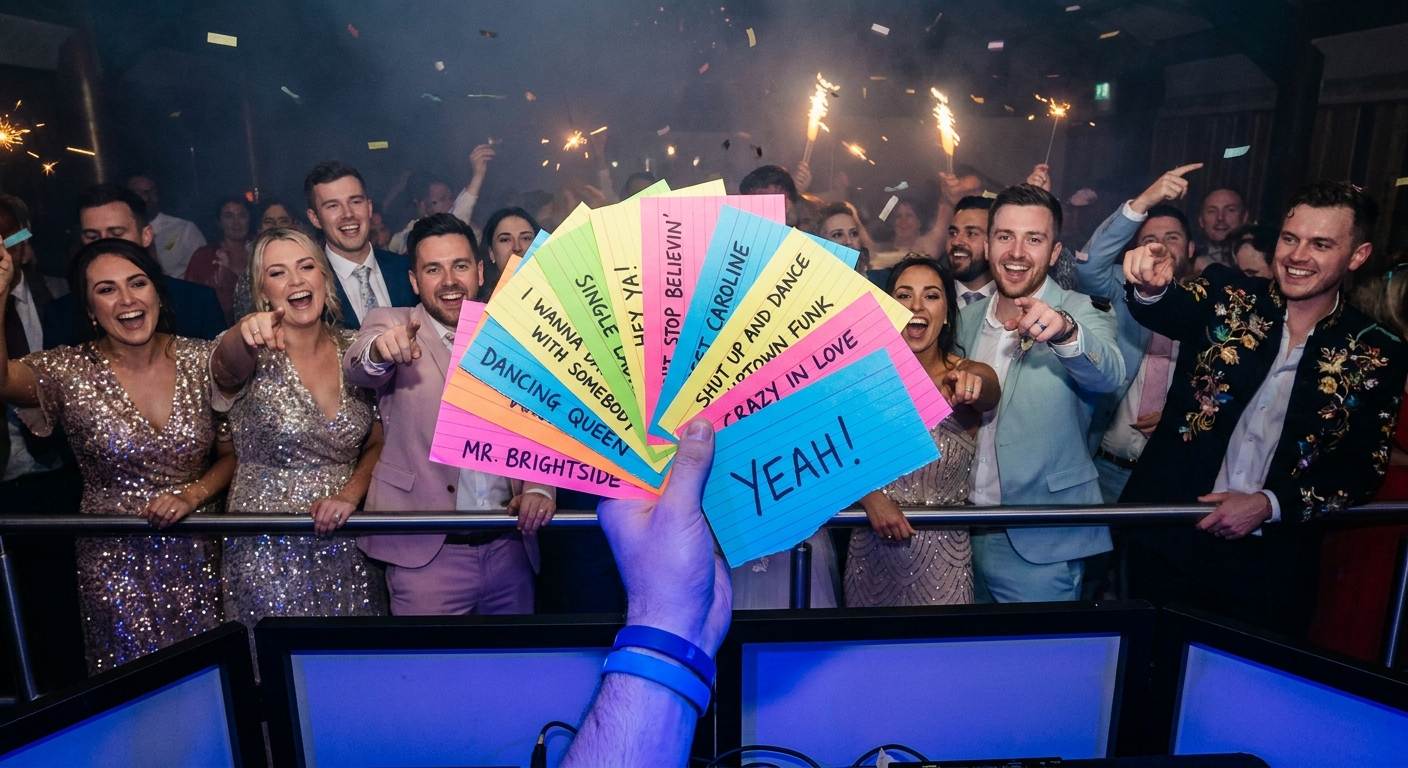
- "Don't Stop Believin'" by Journey — Sing-along rock anthem that unites everyone on the dance floor.
- "Dancing Queen" by ABBA — Disco classic that's guaranteed to fill the dance floor.
Here are some additional "must-have" tracks for your dance playlist:
- "Billie Jean" by Michael Jackson — Iconic pop song with an undeniable groove
- "I Wanna Dance with Somebody (Who Loves Me)" by Whitney Houston — High-energy dance anthem
- "Yeah!" by Usher ft. Lil Jon & Ludacris — Crunk classic that always gets the crowd hyped
- "Mr. Brightside" by The Killers — Indie rock anthem with a massive sing-along chorus
Using PartyMusicPlaylist to Organize Your Sets
Creating and managing DJ playlists can be a daunting task, especially if you have a large music library. Fortunately, there are tools available to help you streamline the process. PartyMusicPlaylist is a fantastic free online event playlist creator that helps you organize your music, collaborate with guests, and export your playlists to various DJ software programs.
With PartyMusicPlaylist, you can:
- Create custom playlists for different events and themes.
- Invite guests to add their song requests.
- Organize your tracks by genre, BPM, and key.
- Export your playlists to Serato DJ, Traktor Pro, and other DJ software.
Using a tool like PartyMusicPlaylist can save you a ton of time and effort, allowing you to focus on the creative aspects of DJing, such as mixing and performance.
You can even discover local DJs in your area directly through PartyMusicPlaylist, making it a one-stop shop for all your DJ needs.
Avoiding Common DJ Playlist Mistakes
Even experienced DJs can fall into common playlist traps. Knowing what not to do is just as important as knowing what to do. Here are some common mistakes to avoid:
⚠️ Heads Up: Playing the same songs every time. Variety is the spice of life, and your audience will appreciate hearing new and exciting tracks.
⚠️ Heads Up: Ignoring the crowd's reaction. Pay attention to how people are responding to your music and adjust your playlist accordingly. If they're not dancing, switch it up!
⚠️ Heads Up: Poor transitions. Abrupt transitions can kill the vibe and disrupt the flow of your set. Practice your mixing skills and master intro/outro techniques.
⚠️ Heads Up: Failing to read the room. Playing music that's inappropriate for the event or audience is a surefire way to clear the dance floor. Always consider the context and tailor your playlist accordingly.
Here's a checklist to keep you on track:
- ✅ Research your audience beforehand.
- ✅ Vary your music selection.
- ✅ Practice your transitions.
- ✅ Pay attention to the crowd's reaction.
- ✅ Be prepared to adapt.
Incorporating Guest Requests Strategically
Guest requests can be a double-edged sword. On one hand, they can add a personal touch to your set and make people feel more involved. On the other hand, they can disrupt your carefully crafted flow and throw off your energy.
The key is to incorporate guest requests strategically. Don't just blindly play every request that comes your way. Be selective and choose the requests that fit the overall vibe of your set. If someone requests a song that's completely out of place, politely decline and explain that it doesn't quite fit the mood.
Here are some tips for handling guest requests:
- Set expectations: Let people know that you can't guarantee you'll play every request.
- Be polite: Even if you can't play a request, thank the person for their suggestion.
- Choose wisely: Select requests that fit the overall vibe of your set.
- Be creative: If you can't play the exact song requested, try to find a similar track that fits better.
With PartyMusicPlaylist, you can even let guests submit requests beforehand, allowing you to review and incorporate them into your playlist in advance. This can help you avoid awkward on-the-spot decisions and ensure that you're playing music that everyone will enjoy.
Expert DJ Playlist Tips for the Win
Ready to take your DJ skills to the next level? Here are some expert tips that will help you stand out from the crowd:
Mix in unexpected elements. Surprise your audience with unexpected transitions, remixes, or mashups. This will keep them engaged and show off your creativity.
- Create custom edits. Edit your favorite tracks to create unique versions that are tailored to your style.
- Use acapellas. Layer acapellas over instrumental tracks to create original mashups and remixes.
- Experiment with different genres. Don't be afraid to blend genres and create unexpected combinations.
- Practice, practice, practice. The more you practice, the more confident and skilled you'll become.
📝 Note: Continuously update your music library with new releases and hidden gems. Staying current and having a diverse selection of music will keep your sets fresh and exciting.
Frequently Asked Questions
PartyMusicPlaylist Team
Helping you create the perfect soundtrack for life's most memorable moments. Expert tips on event music planning, DJ coordination, and playlist curation.
Learn MoreReady to Plan Your Event Music?
Create the perfect playlist for your special event. Search songs, organize your timeline, and share with your DJ.
Get Started FreeRelated Articles
Continue reading