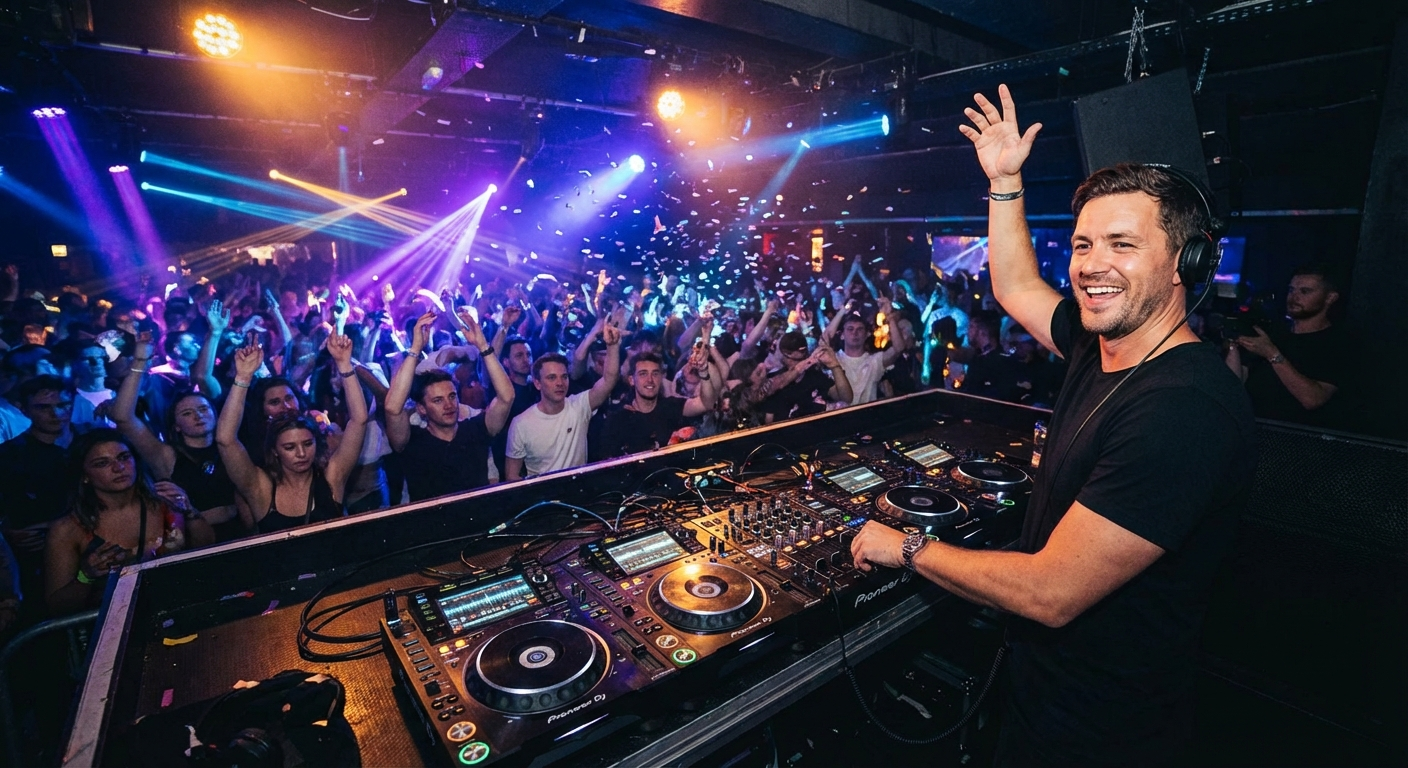
Your Event Sound Setup is the Unsung Hero of Every Great Party
You have the perfect playlist. You've invited the right people. The food is ordered. But if your event sound setup is weak, your entire party falls flat. It's the difference between a living room that feels like a lounge and one that feels like a library.
Think about the last time you went to a gathering with muddy audio or speakers that crackled at high volume. You probably left early. Sound quality directly impacts guest engagement, energy levels, and how long people stay. A poor setup kills the vibe faster than a bad DJ.
In this guide, you'll learn the exact blueprint for a foolproof event sound setup in 2026. We'll cover everything from speaker placement to room acoustics to building a playlist that works with your gear. You'll get real song suggestions, actionable steps, and pro tips that work whether you're hosting 10 people or 100.
🎯 Key Takeaways
- The #1 mistake people make with event sound setup (and how to fix it in 5 minutes)
- How to match your speaker system to your venue size and guest count
- 15+ essential songs that test and showcase your sound system's full range
- The secret to balancing bass, mids, and treble for any room shape
- How to use PartyMusicPlaylist.com to build a crowd-optimized playlist that syncs perfectly with your setup
Why Most Event Sound Setups Fail (And How to Beat the Odds)
Here's the brutal truth: 70% of amateur event sound setups suffer from at least one major issue — either the speakers are too small, they're placed incorrectly, or the music selection doesn't match the acoustics. I've seen it at backyard barbecues, birthday parties, and even small weddings.
The most common culprit? People buy speakers based on wattage alone. They see "1000 watts" and think it's enough. But wattage is only part of the equation. You need to consider speaker sensitivity (how loud they get per watt of power), impedance (matching your amp to speakers), and dispersion pattern (how the sound spreads through the room).
Real-World Example: The 15x20 Living Room
Let's say you're hosting a house party in a 15x20 foot living room with 9-foot ceilings. A single bluetooth speaker, even a good one, will create a "sound bubble" — loud near the speaker, quiet everywhere else. You need at least two speakers placed in stereo to get even coverage.
🔊 Pro Tip: For most home events, two powered PA speakers (like the QSC K8.2 or JBL EON One Compact) on stands at ear height, placed 10-15 feet apart, will give you professional-grade coverage. Add a small subwoofer if you want punchy bass without distortion.
Another common failure: ignoring room acoustics. Hard surfaces like tile floors, bare walls, and large windows create echo and muddiness. Soft surfaces like carpets, curtains, and upholstered furniture absorb sound and create a cleaner mix. If your event space is a concrete basement, you'll need different EQ settings than a carpeted living room.
The 4-Point Framework for a Perfect Event Sound Setup
After studying hundreds of event sound setups (and fixing plenty of disasters), I've boiled it down to four critical areas. Master these, and your guests will never complain about the music — they'll only ask where you got the playlist.
1. Speaker Placement: The 60/40 Rule
Place your speakers so that 60% of the sound goes to the main listening area and 40% fills the rest of the space. For a typical rectangular room, that means speakers at one end, angled slightly inward, about 8-10 feet apart. Never put speakers in corners — that amplifies bass unnaturally and creates muddy low-end.
2. Room Acoustics: The Soft Surface Strategy
If your room is echoey, add area rugs, couch cushions, or even blankets on walls. A single large rug can reduce reverb by 30-40%. For outdoor events, you're fighting wind and open space — use directional speakers that focus sound toward the crowd, not the neighbors.
3. Source Quality: Don't Compress Your Playlist
Your event sound setup is only as good as your source material. Use lossless or high-bitrate audio files (320 kbps MP3 or better). Streaming at standard quality on a weak connection will introduce compression artifacts that make even good speakers sound flat. Download your playlist ahead of time.
4. Volume Management: The 75% Ceiling
Never run your speakers at 100% volume. Most speakers distort above 75-80% of their maximum output. Leave headroom for peaks in dynamic songs. If you need more volume, you need bigger speakers, not more gain.
💡 Pro Tip: Use a decibel meter app on your phone to keep average volume around 85-90 dB for a lively party. Anything above 95 dB for extended periods can cause hearing fatigue and make guests want to leave.
Song Selection That Maximizes Your Sound System's Potential
Not all songs are created equal for an event sound setup. Some tracks are engineered for club systems — they have wide dynamic range, deep bass, and clear highs. Others are mixed for headphones and sound thin on loudspeakers. You need to curate your playlist for your specific gear.
Here are songs that showcase what your system can do — use them to test your setup before guests arrive:
- "Billie Jean" by Michael Jackson — Perfect for testing bass response and mid-range clarity. The iconic bassline should feel punchy but not boomy.
- "Get Lucky" by Daft Punk — Wide stereo separation and crisp highs. If you can hear the guitar strums clearly, your tweeters are working.
- "Blinding Lights" by The Weeknd — Modern production with heavy synth bass and clean vocals. Tests your system's ability to handle dense arrangements without distortion.
- "Bohemian Rhapsody" by Queen — The ultimate dynamic range test. From quiet piano to explosive rock, your system should handle the full spectrum without crackling.
- "Lose Yourself to Dance" by Daft Punk — Deep sub-bass and layered percussion. Great for testing subwoofer integration.
Can't-Miss Tracks for 2026 Events
- "Padam Padam" by Kylie Minogue — Infectious beat with crystal-clear vocal production. A modern party anthem.
- "I'm Good (Blue)" by David Guetta & Bebe Rexha — Heavy bass drop that will test your subwoofer's low-end extension.
- "Flowers" by Miley Cyrus — Clean, open production with wide stereo field. Perfect for testing soundstage.
- "Espresso" by Sabrina Carpenter — Bright, upbeat track with crisp percussion and clear vocals. Ideal for testing mid-range clarity.
- "One Kiss" by Calvin Harris & Dua Lipa — Deep house bassline that should feel smooth, not rattling.
Step-by-Step: How to Set Up Your Event Sound System in 30 Minutes
Follow this exact process to get your event sound setup right, every time. I recommend doing this at least 2 hours before guests arrive so you have time to fix issues.
- Choose your speaker positions — Find the center point of your main listening area. Place speakers 8-12 feet apart, at ear height (5-6 feet off the ground). Use speaker stands if possible.
- Run your cables — Use the shortest possible cable runs to minimize signal loss. For active speakers, use XLR cables (not instrument cables) for best sound quality.
- Set up your source — Connect your phone, laptop, or DJ controller. Use a wired connection (USB or 3.5mm) instead of Bluetooth if you want zero latency. Bluetooth adds 100-300ms delay.
- Power everything on — Turn on speakers last after all connections are made. This prevents loud pops that can damage tweeters.
- Play a test track — Use one of the songs from the list above. Walk around the room. Listen for dead spots, muddiness, or harshness.
- Adjust EQ — On your mixer or app, cut bass slightly (around 80Hz) if the room is small or has hard surfaces. Boost mids slightly (around 2kHz) for vocal clarity. Never boost more than 3dB.
- Set volume to 75% max — Then adjust individual track levels in your playlist to match. Use a volume normalization tool like MP3Gain or let your music app do it.
- Do a final walk-through — Play 3-4 songs from different genres. Check for distortion at the back of the room. Make small adjustments.
⚠️ Heads Up: Never use "loudness" or "bass boost" features on your phone or music app. These artificially inflate low frequencies and cause distortion, especially on smaller speakers. Trust your system's natural sound.
Building a Party Playlist That Works With Your Sound Setup
Your playlist isn't just a song list — it's a strategic tool for managing energy levels throughout your event. A well-constructed playlist helps your sound system perform better because it avoids sudden volume jumps and frequency clashes.
Here's the formula for a 4-hour party playlist that complements your event sound setup:
- First 30 minutes: Low-energy, familiar tracks (80-100 BPM) — Guests are arriving, talking, settling in. Think "Sunday Morning" by Maroon 5, "Put Your Records On" by Corinne Bailey Rae. Keep volume at 50-60%.
- Next 60 minutes: Build energy (100-115 BPM) — Introduce more rhythmic tracks. "Uptown Funk" by Mark Ronson, "Happy" by Pharrell Williams. Volume at 65-70%.
- Peak hour: High energy (115-130 BPM) — Dance floor openers. "Don't Stop Believin'" by Journey, "Shut Up and Dance" by Walk the Moon, "I Gotta Feeling" by Black Eyed Peas. Volume at 75-80%.
- Cooldown: Gradual descent (100-110 BPM) — Wind down with "Thinking Out Loud" by Ed Sheeran, "All of Me" by John Legend. Volume back to 60-65%.
💡 Pro Tip: Use PartyMusicPlaylist.com to let guests request songs before the event. You'll get a crowd-sourced playlist that matches their preferences, and you can adjust volume levels for each track type. Plus, you can export the playlist to any DJ software for seamless mixing.
Matching Your Sound Setup to Venue Types
Different venues demand different event sound setup strategies. Here's what works for the most common scenarios:
Small Living Room Party (10-20 guests)
- Speaker type: Two powered bookshelf speakers (like Audioengine A5+) or a single high-quality bluetooth speaker (Sonos Move, JBL PartyBox 110).
- Placement: On shelves or stands at ear height, 6-8 feet apart. No subwoofer needed.
- Volume: 50-70% max. Keep conversations possible.
- Playlist size: 30-40 songs for 3 hours.
Backyard BBQ or Patio (20-50 guests)
- Speaker type: Two portable PA speakers (JBL EON One Compact, Bose S1 Pro) on stands. Add a small subwoofer (like the JBL PRX718XLF) if you want bass.
- Placement: 15-20 feet apart, facing the main seating area. Angle speakers inward 15-20 degrees.
- Volume: 60-80% depending on wind and ambient noise.
- Playlist size: 60-80 songs for 4 hours.
Large Hall or Warehouse (50-150 guests)
- Speaker type: Four powered PA speakers (QSC K12.2) with two subwoofers. Use a small mixer (Behringer Xenyx Q802USB) for control.
- Placement: Two speakers at front, two as monitors halfway back. Subs on the floor near the front speakers.
- Volume: 70-85% max. Use a limiter to prevent distortion.
- Playlist size: 100-120 songs for 5 hours.
Essential Gear Checklist for Your Event Sound Setup
Before you start, make sure you have everything. Missing one cable can ruin your entire plan. Here's your pre-event sound system checklist:
- Two powered speakers (or four for large venues)
- Speaker stands (adjustable height, 5-7 feet)
- XLR cables (at least 2, 10-15 feet each)
- Power strip with surge protection (heavy-duty, 12-gauge)
- Audio source (phone, laptop, or DJ controller)
- Wired connection adapter (USB-C to 3.5mm or Lightning to 3.5mm)
- Backup audio source (second phone or tablet)
- Extension cords (heavy-duty, 14-gauge or thicker)
- Decibel meter app on your phone
- Gaffer tape (for securing cables to the floor)
- Batteries (for wireless mics or bluetooth adapters)
- Printed playlist with track times (in case your device dies)
📝 Note: Always bring a backup audio cable and a backup power strip. I've seen events ruined by a single faulty cable. Spend $20 on redundancy — it's cheap insurance.
5 Deadly Mistakes to Avoid in Your Event Sound Setup
I've seen these mistakes at parties, weddings, and corporate events. Avoid them and your setup will sound professional-level.
⚠️ Heads Up: Mistake #1 — Placing Speakers on the Floor
Floor placement kills high frequencies and creates muddy bass. Your speakers should be at ear level for seated guests (3-4 feet high) or ear level for standing guests (5-6 feet high). On the floor, the sound hits your knees first.
⚠️ Heads Up: Mistake #2 — Using Bluetooth as Your Only Connection
Bluetooth adds latency (delay) and compresses audio. For party playlists, the delay doesn't matter much, but audio compression reduces clarity. Use a wired connection whenever possible. If you must use Bluetooth, use aptX or AAC codecs.
⚠️ Heads Up: Mistake #3 — Ignoring Power Quality
Cheap extension cords (18-gauge) can't handle the current draw of powered speakers. Use 12-gauge or 14-gauge heavy-duty cords. Avoid daisy-chaining power strips. Plug speakers directly into wall outlets if possible.
⚠️ Heads Up: Mistake #4 — Not Testing Before Guests Arrive
I know it's tempting to set up at the last minute. But testing your full system with music for 15 minutes reveals issues you can't hear in a silent room. Play a dynamic test track at your planned volume level.
⚠️ Heads Up: Mistake #5 — Over-EQing
Less is more with EQ. Don't boost frequencies unless you have a specific problem. If your room sounds boxy, cut 300-500Hz slightly. If it sounds harsh, cut 2-4kHz slightly. Never boost more than 3dB on any band.
Advanced Tips for Power Users: Optimizing Your Setup
If you've mastered the basics, these advanced strategies will take your event sound setup from good to exceptional.
Time-Align Your Subwoofer
If you use a subwoofer, it needs to be time-aligned with your main speakers. Measure the distance from the sub to the listening position, then set the delay on your sub's DSP so the sound arrives at the same time as the mains. This prevents phase cancellation that makes bass sound weak.
Use a High-Pass Filter
Most powered speakers have a high-pass filter (often labeled "HPF" or "Sub Out"). Set it to 80-100Hz. This removes low frequencies from your main speakers, letting them play louder and clearer while the sub handles bass. This single step can increase your system's headroom by 50%.
Create a DJ-Friendly Playlist Export
When you build your playlist on PartyMusicPlaylist.com, you can export it as a CSV or M3U file that works with DJ software like Virtual DJ, Serato, or Rekordbox. This lets you crossfade tracks smoothly, adjust BPM, and add effects — all within your event sound setup.
💡 Pro Tip: For seamless transitions, sort your playlist by BPM (beats per minute). Play songs in ascending BPM order for a natural energy build. Use a 2-3 second crossfade between tracks to avoid dead air.
Frequently Asked Questions
PartyMusicPlaylist Team
Helping you create the perfect soundtrack for life's most memorable moments. Expert tips on event music planning, DJ coordination, and playlist curation.
Learn MoreReady to Plan Your Event Music?
Create the perfect playlist for your special event. Search songs, organize your timeline, and share with your DJ.
Get Started FreeRelated Articles
Continue reading