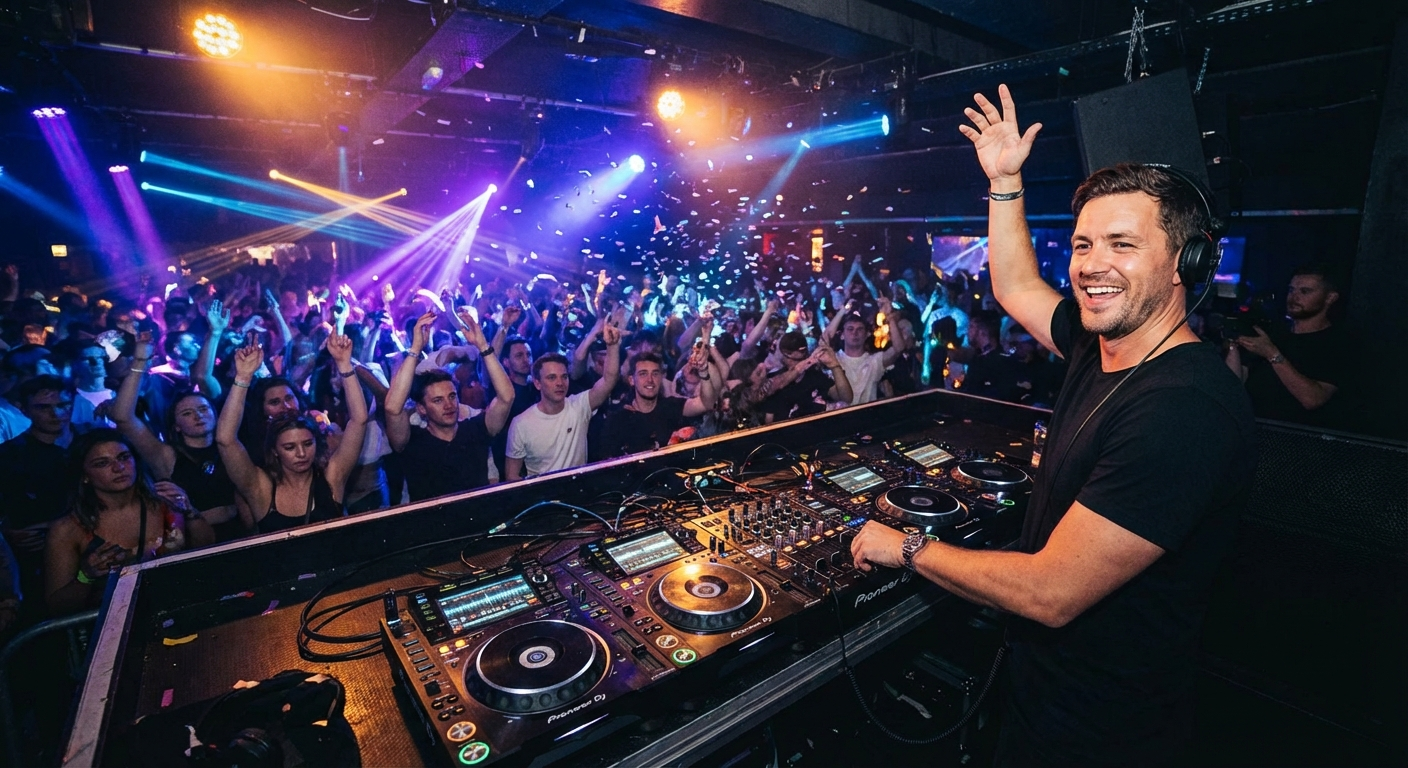
You've spent hours curating the perfect Spotify playlist. You've agonized over transitions, debated between the album version and the single edit, and tested the flow on your morning commute. But here's the hard truth: your carefully crafted playlist might be killing the party.
A pre-made song list, no matter how good, is a frozen artifact. A live DJ is a living, breathing energy conductor. The difference between a DJ vs Spotify playlist isn't just about who pushes play — it's about who reads the room, adapts in real-time, and creates moments that people remember for years.
In this comprehensive guide, you'll discover exactly why a live DJ outperforms any algorithm. You'll learn the specific skills DJs use to manipulate energy, the types of music a playlist simply can't handle, and how you can bridge the gap between convenience and live performance. By the end, you'll know exactly when to hire a DJ and when a playlist will suffice — and how to make either choice work brilliantly.
🎯 Key Takeaways
- A live DJ reads and responds to crowd energy in real-time — a skill no algorithm can match
- DJs can fix pacing problems instantly, while playlists are stuck with whatever you pre-programmed
- Professional DJs bring equipment expertise, backup systems, and seamless mixing that playlists can't replicate
- Certain moments (first dance, cake cutting, grand entrance) demand human timing and intuition
- You can still use PartyMusicPlaylist.com to collect guest song requests and share your vision with a DJ for the best of both worlds
The Algorithm vs. Human Instinct: Why Reading a Room Matters
Spotify's algorithm is impressive. It analyzes your listening history, suggests songs based on what similar users enjoy, and creates playlists that feel eerily personal. But there's something it fundamentally cannot do: read a physical room full of people.
Imagine this scenario. You're at a wedding reception. The dance floor is packed to "Uptown Funk" by Bruno Mars. Everyone is singing, laughing, sweating. The song ends. A live DJ sees that the energy is peaking — people are hungry for more. They drop "24K Magic" immediately. The party continues to build.
Now imagine the same scenario with a Spotify playlist. "Uptown Funk" ends. The next song on your list is "Thinking Out Loud" by Ed Sheeran — a beautiful song, but a complete momentum killer. The dance floor clears. People head back to their tables. The energy you spent 20 minutes building evaporates in 10 seconds.
- Energy detection — DJs scan body language, eye contact, and foot tapping to gauge engagement
- Momentum management — DJs know when to accelerate and when to give the crowd a breather
- Real-time adjustment — If a song flops, a DJ pivots within 15 seconds; a playlist is stuck for 3-4 minutes
💡 Pro Tip: If you're using a playlist, watch your guests like a hawk. The moment you see energy dip, physically walk to the device and skip to a more upbeat track. Don't let your pre-planned order ruin the vibe.
Song Selection: The Science of Flow and Timing
A great DJ doesn't just play good songs. A great DJ constructs a narrative arc. They think about energy levels, key compatibility, BPM progression, and lyrical content in ways that even the smartest algorithm cannot.
Consider BPM (beats per minute). A typical party starts around 100-110 BPM, builds to 120-130 BPM during peak hours, and might drop to 90-100 BPM for a late-night wind-down. A playlist with a random shuffle will jump from 128 BPM to 85 BPM and back again, creating a jarring experience.
DJs also think about key mixing — keeping songs in compatible musical keys so transitions feel smooth rather than clashing. The Camelot Wheel system helps DJs know which keys harmonize. Spotify doesn't do this automatically in its playlists.
How DJs Build a Setlist
Professional DJs often follow a structured approach to set building:
- Start with familiarity — Open with songs people know and love to build trust
- Introduce variety — Mix genres, eras, and tempos to keep things interesting
- Build to peaks — Sequence 3-4 high-energy songs together, then drop to a mid-tempo breather
- End with a memorable finish — Close with an anthem that leaves everyone smiling
⚠️ Heads Up: Over-planning your playlist is a common mistake. Leave room for spontaneity. If a song unexpectedly kills the vibe, have a backup queue ready. Rigid playlists are fragile playlists.
The Equipment Factor: Why DJ Gear Matters
Let's talk about sound quality. Your phone or laptop plugged into a consumer speaker system is not the same as professional DJ equipment. DJs use high-quality mixers, controllers, and speakers designed for large spaces with challenging acoustics.
A DJ's mixer allows for seamless transitions, EQ adjustments, and effects that can save a questionable song choice. If a track sounds muddy in a room with bad acoustics, a DJ can cut the bass, boost the mids, and make it work. A playlist has zero ability to adapt to the room's sound profile.
There's also the reliability factor. A DJ brings backup equipment. If a laptop crashes, there's a second one ready. If a speaker blows, there's a spare. Your Spotify playlist lives on a single device that could die, lose signal, or get bumped off the Wi-Fi network.
The Hidden Cost of DIY: Renting professional-grade speakers, a subwoofer, and a mixer for a single event can cost $200-$500. A DJ brings all of that — plus their expertise — in one package. Factor equipment rental into your playlist vs. DJ cost comparison.
Special Moments: When Human Timing Is Everything
Some moments at an event require split-second timing that a playlist simply cannot provide. Think about these scenarios:
- First dance — The song needs to start exactly when the couple steps onto the floor, not 30 seconds earlier because of a playlist delay
- Cake cutting — The DJ watches for the knife to touch the cake and drops the celebratory song on cue
- Grand entrance — The DJ times the music to the exact moment the couple walks through the door, building anticipation with a drum roll or build-up
- Bouquet toss — The song peaks exactly when the bouquet is thrown, creating a perfect photo moment
- Last song of the night — A DJ builds to a final emotional crescendo; a playlist just ends
These moments are not about the song choice — they're about the human connection between the music and the action. A DJ watches, listens, and acts with perfect timing. A playlist has no eyes or ears.
Guest Interaction: The DJ as Social Conductor
A great DJ does more than play music. A great DJ manages the social energy of the room. They make announcements, engage with guests, and create a sense of community that no speaker system can replicate.
Consider the difference between hearing "Put your hands up!" from a recording versus from a live person who can see your reaction. A DJ can read the crowd's response and adjust their energy accordingly. If people look confused, the DJ explains what's happening. If people are hesitant to dance, the DJ might play a familiar song and physically gesture for people to join the floor.
There's also the request management aspect. A guest walks up and asks for a specific song. A DJ can either play it immediately, explain why it doesn't fit right now, or promise to play it later. A playlist ignores the request entirely. That guest feels ignored and disconnected from the event.
💡 Pro Tip: Use PartyMusicPlaylist.com to collect guest song requests before your event. Share that list with your DJ so they know exactly what your crowd wants to hear. It's the perfect hybrid approach — guest input with professional execution.
Cost Analysis: The Real Financial Picture
Let's be honest about money. Hiring a professional DJ costs significantly more than building a Spotify playlist. But the value difference is equally significant.
Here's what your DJ fee covers beyond just the music:
- Pre-event consultation — Learning your taste, your timeline, and your special moments
- Equipment rental and setup — Professional speakers, mixers, microphones, and backup systems
- Insurance coverage — Liability insurance for the venue's protection
- MC services — Making announcements, coordinating with vendors, keeping the schedule on track
- Experience and judgment — Handling unexpected situations (broken equipment, rude guests, timeline delays)
The question isn't "Can a playlist replace a DJ?" It's "What is the experience worth to you?" For a casual backyard barbecue, a playlist is perfect. For a wedding, milestone birthday, or corporate gala? The investment in a professional DJ pays for itself in memories and smooth execution.
When a Spotify Playlist Actually Wins
Let's be fair. There are situations where a well-crafted Spotify playlist is the better choice. Knowing when to use each option is the mark of a smart event planner.
Playlist-Friendly Scenarios
- Casual gatherings — Small dinner parties, backyard cookouts, game nights with 10-20 people
- Background music events — Brunches, cocktail hours, networking mixers where conversation is the focus
- Budget-constrained events — Student parties, small community gatherings, informal celebrations
- Specific niche genres — If you need obscure electronic music, rare jazz recordings, or hyper-specific playlists that a DJ might not know
- Multi-room events — You can run different playlists in different rooms simultaneously (though a DJ can manage this too with proper setup)
The key is matching the tool to the event. A playlist is a tool for convenience and control. A DJ is a tool for energy, adaptability, and showmanship. Choose based on what your event needs most.
Song Lists by Moment: What Works Best with a DJ
If you do hire a DJ, here are the songs that work best for specific moments. Notice the range of tempos and moods — a DJ can transition between these seamlessly.
High-Energy Openers (Get the Party Started)
- "Don't Stop Believin'" by Journey — Universal singalong that crosses generations
- "I Wanna Dance with Somebody" by Whitney Houston — Instant crowd-puller to the floor
- "Shut Up and Dance" by Walk the Moon — Modern anthem with clear instructions
- "September" by Earth, Wind & Fire — Timeless funk that works for all ages
- "Uptown Funk" by Bruno Mars — Guaranteed energy spike from the first beat
Editor's Top Picks
- "Don't Stop Believin'" by Journey — The ultimate crowd unifier; everyone knows the chorus
- "September" by Earth, Wind & Fire — Perfect BPM (120) for getting people moving without exhausting them
Romantic Slow Dances
- "At Last" by Etta James — Classic first dance choice with timeless elegance
- "Perfect" by Ed Sheeran — Modern ballad with universal appeal
- "Can't Help Falling in Love" by Elvis Presley — Generational favorite for all ages
- "All of Me" by John Legend — Emotional depth with singalong potential
- "Unchained Melody" by The Righteous Brothers — Dramatic and romantic for a memorable moment
Late-Night Dance Floor Bangers
- "Get Lucky" by Daft Punk ft. Pharrell Williams — Irresistible groove that builds energy
- "Levitating" by Dua Lipa — Modern disco-pop with high BPM (103)
- "I Gotta Feeling" by The Black Eyed Peas — The ultimate "the night is young" anthem
- "Party Rock Anthem" by LMFAO — Cheesy but effective; instructions included in the lyrics
- "Yeah!" by Usher ft. Lil Jon & Ludacris — Pure energy from the first second
💡 Pro Tip: Create a playlist template on PartyMusicPlaylist.com with your must-play songs, do-not-play songs, and guest requests. Share this with your DJ at least two weeks before the event. This ensures your vision guides their performance without stifling their creativity.
Common Mistakes to Avoid When Choosing Between DJ and Playlist
You've read the arguments. Now let's talk about the pitfalls that trip up even experienced event planners.
⚠️ Heads Up: Mistake #1 — Assuming a Playlist Is "Set and Forget"
A playlist still needs active management. You need to monitor volume levels, skip songs that aren't working, handle requests, and adjust for unexpected moments. If you're the host, you can't do this while also greeting guests, eating dinner, and managing other logistics. Someone needs to be the "playlist babysitter."
⚠️ Heads Up: Mistake #2 — Overloading the DJ with Requests
Trust your DJ's judgment. If you give them a list of 100 must-play songs, you're essentially asking them to be a human jukebox. A good DJ needs flexibility to read the room. Provide 20-30 essential songs and let them fill the rest.
⚠️ Heads Up: Mistake #3 — Ignoring Audio Quality
Spotify streams at 320 kbps at best. Professional DJs use lossless audio files (FLAC, WAV) that sound significantly better on large sound systems. If you're renting speakers, the difference is audible. Consider downloading high-quality versions of your most important songs.
⚠️ Heads Up: Mistake #4 — Skipping the Pre-Event Meeting
Whether you hire a DJ or use a playlist, have a clear plan. Write down the timeline, special moments, and guest demographics. A DJ needs this information to prepare. A playlist needs this information to be sequenced correctly.
Expert Tips for Making Either Choice Work
You've made your decision. Now make it excellent. Here's how to optimize your experience whether you choose a DJ or a playlist.
If You Choose a DJ
- Provide a detailed timeline — Include every special moment with approximate times
- Share your do-not-play list — Be specific about songs you absolutely don't want
- Let them set up early — Give them at least 60 minutes to sound check the room
- Trust their judgment — If they say a song won't work, listen to their reasoning
- Use guest song requests — Collect requests ahead of time and share the list
If You Choose a Playlist
- Designate a playlist manager — One person who handles volume, skipping, and requests
- Create multiple playlists — Dinner music, party music, late-night chill music — switch between them
- Download everything offline — Wi-Fi failures happen at the worst moments
- Test your sound system — Set it up, play music at party volume, and walk the room to check for dead spots
- Build in flexibility — Leave empty slots in your sequence for spontaneous moments
TL;DR: Hire a DJ for events where energy, timing, and adaptability matter most (weddings, milestone parties, corporate events). Use a Spotify playlist for casual gatherings where background music suffices. The best approach? Use PartyMusicPlaylist.com to collect guest input, then decide based on your budget and event complexity.
The Future of DJ vs. Playlist: What's Coming in 2026
The line between DJs and playlists is blurring. New tools are emerging that combine the best of both worlds. AI-assisted DJ software can now analyze crowd reactions through phone sensors and adjust song selection in real-time. Some platforms offer hybrid solutions where a human DJ controls the flow but uses AI suggestions for song choices.
What hasn't changed — and likely never will — is the value of human presence and intuition. A DJ who can make eye contact, tell a joke between songs, and feel the energy shift in a room will always outperform any algorithm. Technology enhances the DJ's toolkit; it doesn't replace their judgment.
The smartest event planners are already using hybrid approaches. They use playlist planning tools to organize their music, collect guest feedback, and share their vision. Then they hand that information to a professional who brings it to life. You get the convenience of digital planning with the power of live performance.
Frequently Asked Questions
PartyMusicPlaylist Team
Helping you create the perfect soundtrack for life's most memorable moments. Expert tips on event music planning, DJ coordination, and playlist curation.
Learn MoreReady to Plan Your Event Music?
Create the perfect playlist for your special event. Search songs, organize your timeline, and share with your DJ.
Get Started FreeRelated Articles
Continue reading