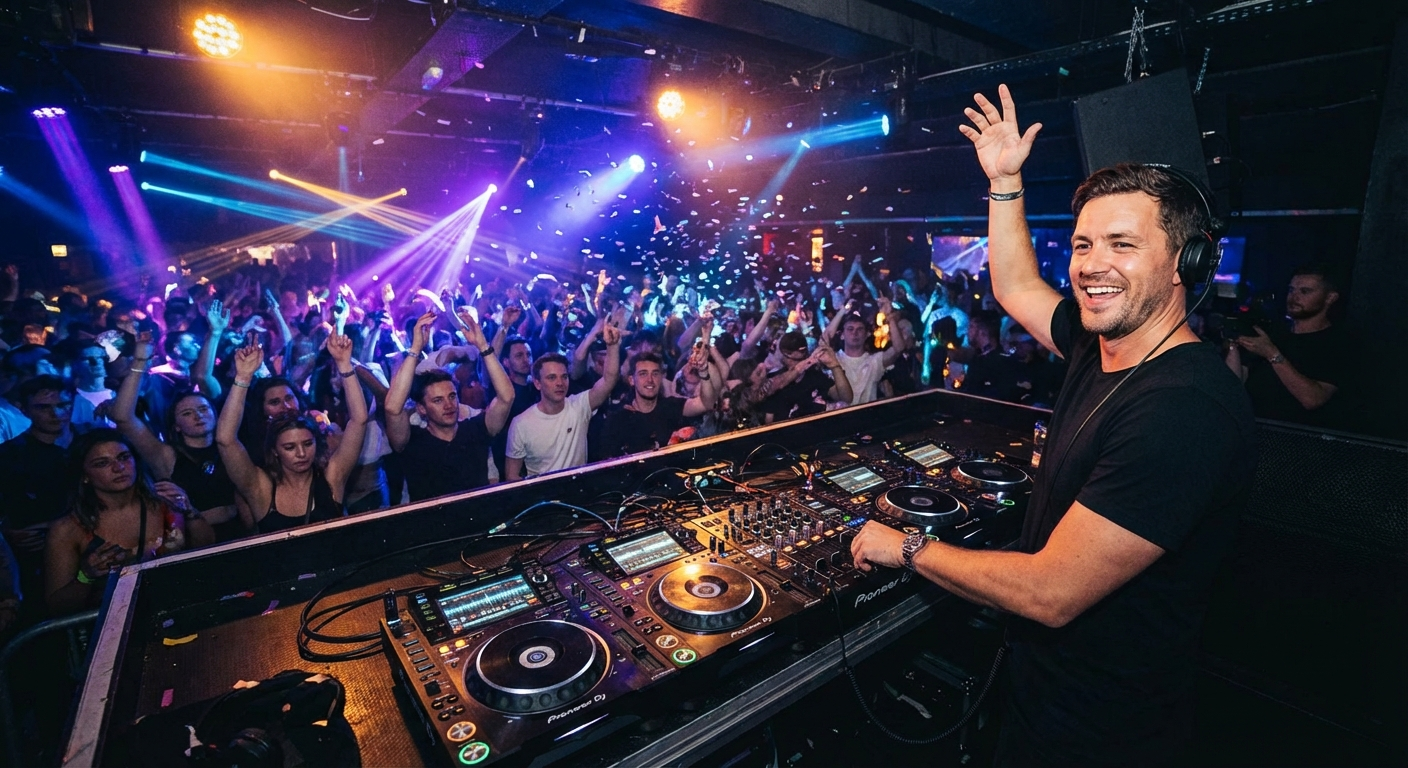
Your Event Sound Setup Is Sabotaging Your Party — Here's How to Fix It
You've spent hours crafting the perfect playlist. You've coordinated with vendors, planned the timeline, and maybe even designed a killer lighting scheme. But when the first song drops, the sound is thin, muddy, or — worst of all — silent in the back of the room.
Your event sound setup is the single most underrated factor in party success. A bad playlist on great speakers beats a great playlist on terrible speakers every time. In 2026, the bar is higher than ever. Guests expect crisp, immersive audio that fills every corner of the venue.
This guide covers 5 essential sound setup hacks that professional DJs use to dominate any room. You'll learn how to position speakers for maximum coverage, dial in EQ like a pro, avoid feedback loops, and choose the right gear for your event size. We'll also give you real song examples that test your system's strengths and weaknesses.
🎯 Key Takeaways
- Speaker placement determines 80% of your sound quality — position them at ear level and away from walls
- EQ adjustments fix muddy bass and harsh highs in under 60 seconds
- Feedback is preventable with proper mic placement and gain staging
- Your playlist needs dynamic range — quiet songs test system clarity, loud songs test headroom
- A subwoofer is non-negotiable for events with more than 50 guests
Why 90% of Event Sound Setups Fail (And How to Avoid It)
Walk into any wedding reception, corporate party, or backyard bash, and you'll hear the same problem: muddy, boomy bass that drowns out vocals, or harsh, piercing highs that make guests cringe. The root cause is almost always poor speaker placement and neglected EQ tuning.
Think of your sound system like a garden hose. If you kink the hose, water trickles out. If you position the nozzle wrong, you soak the wrong area. Your speakers work the same way. A few inches of movement can transform a "meh" experience into a "wow" moment.
The Three Most Common Sound Mistakes
- Speakers on the floor — Low frequencies couple with the ground, creating boomy bass that masks vocals and mids
- Speakers in corners — Corner placement amplifies bass by 6-12 dB, causing muddiness and feedback
- No subwoofer — Full-range speakers can't reproduce deep bass below 50 Hz, leaving your dance floor flat
💡 Pro Tip: Before your event, walk the room with a friend playing music. Stand in every corner, the center, and near the exits. If the sound changes dramatically from spot to spot, your speaker placement needs adjustment. Aim for consistent volume within 3 dB across 90% of the room.
"I once spent $4,000 on a sound system for a 200-person wedding. The first dance sounded like a tin can because I put both speakers on the floor behind the DJ table. After moving them to tripods at ear level, the room came alive. Placement is everything." — Mark R., Professional DJ for 12 years
Hack #1: The Golden Triangle Speaker Placement
The Golden Triangle is a simple rule: your two main speakers and the dance floor form an equilateral triangle. Each speaker should be angled inward toward the center of the dance floor, about 45 degrees from the wall. This creates a stereo sweet spot that covers the maximum listening area.
Step-by-Step Speaker Setup
- Measure your room — Note the length, width, and ceiling height. For rooms over 40 feet long, consider delay speakers mounted halfway back.
- Place speakers at ear level — Use tripod stands (6-8 feet tall) or wall mounts. Never put speakers on the floor or on tables.
- Angle speakers inward — Rotate each speaker 30-45 degrees toward the center of the dance floor. This improves stereo imaging and reduces reflections off side walls.
- Keep speakers 2-3 feet from walls — Especially back walls and corners. This prevents bass buildup and muddiness.
- Test with pink noise — Play pink noise (free apps available) and walk the room. Adjust speaker position until the noise sounds consistent everywhere.
- JBL EON One Compact — Perfect for 50-100 person events, built-in subwoofer
- QSC K12.2 — Industry standard for 100-300 person events, crystal clear mids
- Electro-Voice ELX200-12 — Budget-friendly option with surprising bass output
- Low (Bass, 20-250 Hz) — If it sounds muddy or boomy, cut 2-3 dB around 80-120 Hz. If the kick drum lacks punch, boost 1-2 dB around 60-80 Hz.
- Mid (Vocals, 250 Hz - 4 kHz) — Most vocals live around 1-3 kHz. If vocals are harsh or piercing, cut 1-2 dB around 2-3 kHz. If vocals sound hollow or thin, boost 1-2 dB around 1 kHz.
- High (Hi-hats, cymbals, 4-20 kHz) — If the sound is dull or muffled, boost 1-2 dB around 10-12 kHz. If it's harsh or sibilant, cut 1-2 dB around 6-8 kHz.
- "Get Lucky" by Daft Punk ft. Pharrell Williams — Tests crisp highs (hi-hats) and tight bass (synth bassline)
- "Bohemian Rhapsody" by Queen — Tests dynamic range from whisper-quiet opera to explosive rock
- "Billie Jean" by Michael Jackson — Tests midrange clarity (vocals) and low-end punch (kick drum)
- "Strobe" by deadmau5 — Tests sub-bass extension (below 40 Hz) and stereo imaging
- "Rolling in the Deep" by Adele — Tests vocal clarity and sibilance control (sounds like "s" and "t")
- Never point a microphone at a speaker — Keep mics at least 3 feet away from any speaker, especially the front grille
- Use a cardioid microphone — Cardioid mics pick up sound from the front and reject sound from the rear, reducing feedback risk by 50%
- Set gain properly — Start with the microphone gain at 0, then slowly increase until you hear clear speech at normal speaking volume. If feedback occurs, cut gain, don't boost it
- Use a graphic EQ — Insert a 31-band graphic EQ on your microphone channel. Walk the room while speaking, and cut the frequency that feeds back by 3-6 dB
- Add a feedback eliminator — Devices like the Behringer FBQ1000 automatically detect and notch out feedback frequencies in milliseconds
- Shure SM58 — Industry-standard cardioid vocal mic, rejects feedback like a champ
- Behringer FBQ1000 — Automatic feedback eliminator, under $100, saves your event
- dbx DriveRack PA2 — All-in-one speaker management with feedback suppression, EQ, and limiting
- Use one sub per side — For rooms over 30 feet wide, place one subwoofer near each main speaker. This creates even bass coverage and reduces "dead spots"
- Set the crossover at 80-100 Hz — Most subwoofers have a crossover dial. Set it so the sub handles frequencies below 80-100 Hz, and your main speakers handle everything above. This keeps bass tight and vocals clear
- Phase alignment is critical — If your subwoofer is out of phase with your main speakers, bass will cancel out in certain parts of the room. Use the phase switch on your sub (usually 0° or 180°) and listen for the position that gives the fullest, punchiest bass at the center of the dance floor
- Place the sub on the floor — Unlike main speakers, subwoofers should be on the floor (not on tables or stands). This couples the low frequencies with the ground, increasing perceived bass by 6-10 dB
- "Yeah!" by Usher ft. Lil Jon & Ludacris — The kick drum and 808 bassline will reveal uneven bass coverage
- "Sicko Mode" by Travis Scott — The sub-bass drops below 40 Hz, testing your sub's extension
- "Uptown Funk" by Mark Ronson ft. Bruno Mars — Tight, punchy bass that should feel like a heartbeat, not a rumble
- "Low" by Flo Rida ft. T-Pain — Classic party track that rewards proper subwoofer phase alignment
- Cocktail hour: 75-80 dB — Background music for conversation. Use vocal-light tracks like "Put Your Records On" by Corinne Bailey Rae or "Banana Pancakes" by Jack Johnson
- Dinner: 70-75 dB — Even lower to facilitate conversation. Soft jazz or acoustic covers work well, like "Fly Me to the Moon" by Frank Sinatra
- Dancing: 85-95 dB — Full party volume. Tracks like "Don't Stop Believin'" by Journey or "I Wanna Dance with Somebody" by Whitney Houston shine here
- Peak moment: 95-100 dB — For short bursts (2-3 songs max). Use high-energy anthems like "Livin' on a Prayer" by Bon Jovi or "Party in the U.S.A." by Miley Cyrus
- Mistake: Using Bluetooth speakers for large events — Bluetooth adds latency (delay) and compresses audio. Use wired XLR cables for reliable, high-quality sound
- Mistake: Ignoring room acoustics — Hard surfaces (concrete, glass) create echo and harsh reflections. Add rugs, curtains, or acoustic panels to absorb excess sound
- Mistake: Not having a backup system — A single speaker failure can kill your event. Carry a spare speaker, cables, and a backup mixer
- Mistake: Overloading the electrical circuit — Professional sound systems draw 10-20 amps. Use a power conditioner and check your venue's circuit capacity to avoid tripping breakers
- Mistake: Skipping the sound check — Always arrive 2-3 hours early to set up and test. A rushed setup leads to feedback, bad EQ, and unhappy guests
- Use delay speakers for long rooms — If your room is over 50 feet long, place a second pair of speakers halfway back. Set a 10-30 millisecond delay on these speakers using your mixer or a delay processor. This keeps sound arriving at the same time to listeners in the back, eliminating echo
- Implement side-fill speakers — For weddings or corporate events with a stage, position small speakers on the sides facing outward. This covers guests sitting near the stage who would otherwise hear only the backs of the main speakers
- Use a system alignment tool — Software like Smaart v8 or Room EQ Wizard measures your room's frequency response and suggests precise EQ cuts. Pro DJs use these to dial in perfection
- Invest in a digital mixer — Digital mixers (like the Behringer X32 or Allen & Heath SQ-5) let you save EQ presets for different rooms, recall them instantly, and control everything from a tablet
📝 Note: For outdoor events, the Golden Triangle still applies, but you'll need to account for wind and open space. Place speakers closer to the crowd (within 15-20 feet) and aim them slightly downward to keep sound focused on the audience, not the sky.
Hack #2: EQ Like a Pro in 60 Seconds
Equalization (EQ) is the difference between a professional sound and a karaoke nightmare. Most DJs never touch the EQ knobs on their mixer, which is a huge missed opportunity. With three simple adjustments, you can transform any room.
The 3-Band EQ Cheat Sheet
⚠️ Heads Up: Never boost EQ more than 3 dB on any band. Excessive boosting causes distortion and can damage your speakers. When in doubt, cut frequencies instead of boosting — this reduces problem areas without adding noise.
Songs That Test Your EQ
Use these tracks to dial in your system. Each highlights a specific frequency range.
Pro DJs often carry a reference playlist of 5-10 songs they know intimately. They play these same songs at every venue to quickly identify room issues. Build your own reference playlist and learn how each song should sound on a well-tuned system.
Hack #3: Feedback Elimination (Save Your Ears and Your Reputation)
Feedback — that loud, piercing squeal — is the number one party killer. It happens when sound from the speakers enters a microphone and gets re-amplified in a loop. In 2026, with more events using wireless mics for speeches, toasts, and karaoke, feedback is more common than ever.
How to Prevent Feedback Before It Starts
Essential Feedback Prevention Tools
💡 Pro Tip: During sound check, have someone speak into the mic at their normal volume while you walk the room. If you hear feedback in the back of the room, cut 2-3 dB at that frequency on your graphic EQ. Repeat until the room is stable. This takes 5 minutes and prevents 90% of feedback issues.
"I learned the hard way at a 150-person wedding. The best man's toast started with a deafening squeal that lasted 10 seconds. The bride was furious. Now I always run a feedback elimination routine before any event with microphones. It's non-negotiable." — Sarah L., Wedding DJ since 2019
Hack #4: Subwoofer Integration for Deep, Punchy Bass
If your event has more than 50 guests and you're not using a subwoofer, you're leaving energy on the table. Full-range speakers (like 12-inch or 15-inch models) can't reproduce frequencies below 50 Hz with authority. That means the kick drum lacks thump, the bass guitar sounds thin, and the dance floor feels empty.
Subwoofer Setup Best Practices
Songs That Showcase Proper Subwoofer Integration
⚠️ Heads Up: If your subwoofer is placed in a corner, you'll get 6-12 dB of boundary gain at low frequencies. This sounds impressive at first, but it creates uneven bass that's loud in some spots and nonexistent in others. Always place subs at least 2 feet from walls and corners.
Hack #5: Dynamic Range Management (Keep the Energy Flowing)
A great event sound setup isn't just about hardware — it's about how you manage the energy of your playlist. If every song is at the same volume, the party feels flat. If songs jump wildly in volume, guests get annoyed. The goal is controlled dynamic range that builds and releases energy naturally.
Volume Levels by Event Phase
📝 TL;DR: Keep cocktail hour and dinner at 70-80 dB (conversation-friendly). Crank to 85-95 dB for dancing. Never exceed 100 dB for more than a few songs — it fatigues ears and may damage hearing.
How to Build Energy with Volume
Start your dance set at 80 dB with an upbeat but not overwhelming song like "Shut Up and Dance" by Walk the Moon. Gradually increase volume by 1-2 dB every 3-4 songs. After 20 minutes, you'll be at 90 dB with the crowd fully engaged. Then drop a peak anthem like "Mr. Brightside" by The Killers at 95 dB — the energy spike will feel massive because you built up to it.
💡 Pro Tip: Use a sound level meter app (like NIOSH SLM) to measure dB levels at the dance floor. Most smartphones have accurate built-in microphones for this. Check levels every 10 minutes to ensure you're not creeping too loud or too quiet.
Common Event Sound Setup Mistakes (And How to Fix Them)
Even experienced DJs make these errors. Here's what to watch for.
"I once watched a DJ set up 15 minutes before a wedding. He didn't test anything. The first dance had a 2-second delay because his Bluetooth was connected to the wrong device. Guests laughed. The bride cried. Sound check is sacred." — Tom K., Event Planner with 20 years experience
Expert Tips for Advanced Sound Setup
These pro-level techniques separate the amateurs from the professionals. Implement one or two at your next event.
🎯 The Ultimate Sound Setup Checklist
Before every event, run through this list:
1. Speaker placement: Golden Triangle, ear level, away from walls
2. Subwoofer: On floor, crossover at 80-100 Hz, phase aligned
3. EQ: Cut muddy lows, control harsh highs, boost vocal mids
4. Feedback: Cardioid mics, proper gain, graphic EQ cuts
5. Volume: 70-80 dB for dinner, 85-95 dB for dancing, gradual build
6. Backup: Spare speaker, cables, mixer, power conditioner
How PartyMusicPlaylist Makes Sound Setup Easier
You've got the hardware dialed in. Now what about the playlist? A great sound system is wasted on a poorly sequenced playlist. That's where PartyMusicPlaylist comes in.
Our free tool lets you create custom playlists for any event type — weddings, birthdays, corporate parties, or backyard barbecues. You can add guest song requests so everyone hears their favorites, export to DJ software (Serato, Rekordbox, Virtual DJ) for seamless integration, and even find local DJs if you need professional help.
The best part? You can sequence your songs by energy level — cocktail hour, dinner, dancing, peak — so your volume curve matches our dynamic range tips above. Browse our event playlist templates to get started in minutes.
Frequently Asked Questions
PartyMusicPlaylist Team
Helping you create the perfect soundtrack for life's most memorable moments. Expert tips on event music planning, DJ coordination, and playlist curation.
Learn MoreReady to Plan Your Event Music?
Create the perfect playlist for your special event. Search songs, organize your timeline, and share with your DJ.
Get Started FreeRelated Articles
Continue reading