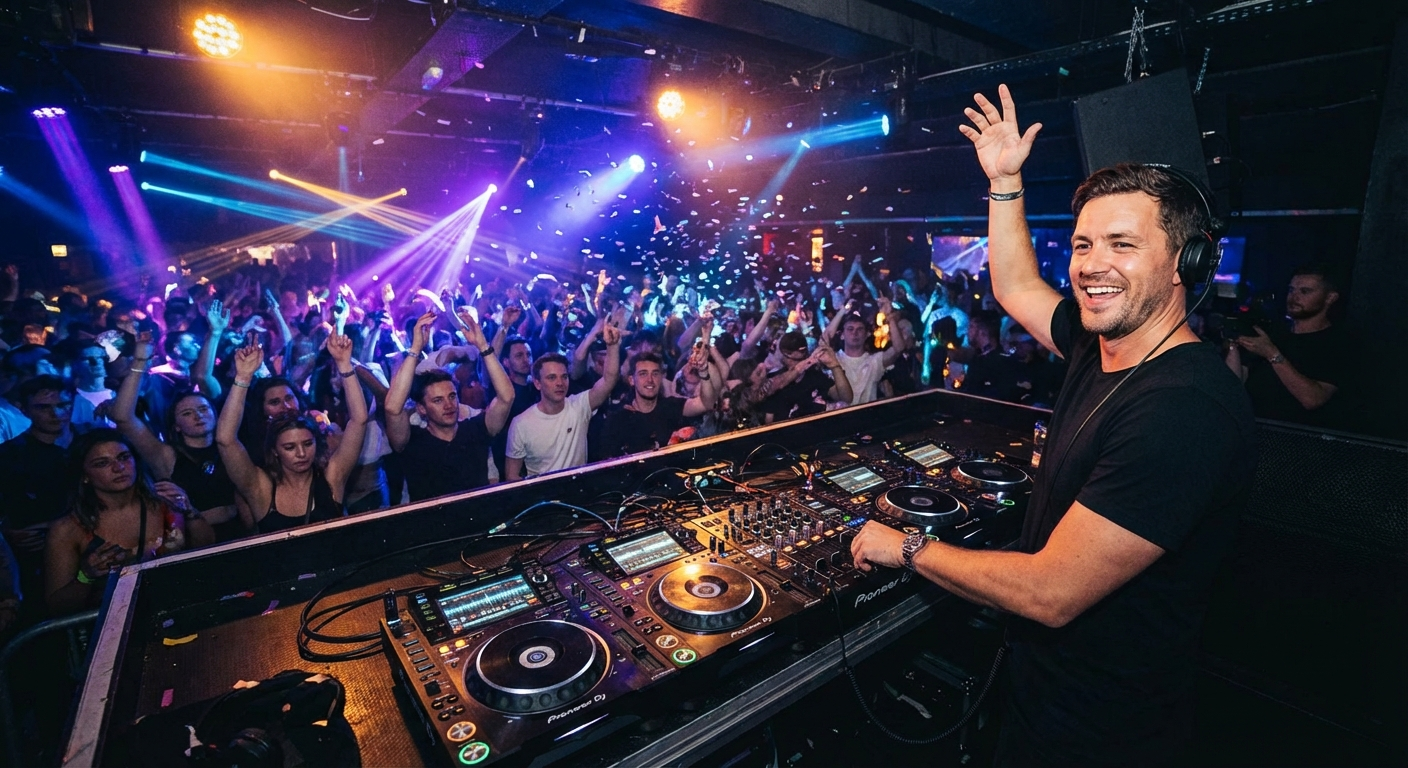
You've just landed a gig. The client asks, "How many songs will you play?" Your mind races. Do you say 50? 80? 120?
Getting this number wrong is a disaster. Play too few songs and the dance floor empties. Play too many and the night feels rushed, like a fast-forward button on a great movie.
The truth is simple: the number of songs per hour is the single most overlooked variable in event planning. Get it right, and you control the energy, the mood, and the memories. Get it wrong, and you're just playing noise.
In this guide, you'll learn the exact formula DJs use to calculate song counts for any event. We'll break down tempo, BPM, genre, and the secret tricks to keep a crowd moving all night long. By the end, you'll never guess again.
🎯 Key Takeaways
- The Golden Rule: Plan for 15-20 songs per hour for a standard event
- Fast-tempo genres (house, EDM) = more songs per hour than slow genres (R&B, jazz)
- Your intro, outro, and transitions eat up valuable time — account for them
- Event type matters: a wedding reception needs fewer songs than a club set
- Use a playlist tool like PartyMusicPlaylist to test your timing before the big night
Why "How Many Songs Per Hour" Matters More Than You Think
Imagine you're driving a car. The speed limit is the tempo of your event. If you drive too fast (too many songs), you crash into fatigue. If you drive too slow (too few songs), you bore your passengers to sleep.
The songs per hour formula is your speedometer. It tells you exactly how much fuel (music) you need for the journey (your event).
Most new DJs make a critical mistake: they think "more songs = better value." They pack 30 songs into an hour. The result? A chaotic mess where no track breathes, nobody dances, and the vibe dies before it starts.
On the flip side, playing only 8 songs in an hour makes your set feel sluggish. Guests check their watches. The energy flatlines.
The sweet spot is 15-20 songs per hour. This range gives you room to build energy, let great tracks play out, and keep the dance floor packed.
But here's the catch: that number changes depending on your genre, your event, and your crowd. Let's dig into the math.
💡 Pro Tip: Always over-prepare. Pack 25-30 songs per hour in your crate. You'll only play 15-20 live, but having extras means you can read the room and pivot instantly.
The Simple Math: How to Calculate Songs Per Hour
Let's do the math together. It's not calculus. It's basic arithmetic.
A standard song on the radio runs 3 to 4 minutes long. That includes intro, verse, chorus, verse, chorus, bridge, and outro.
Here's the breakdown:
- 3-minute song = 20 songs per hour (60 ÷ 3)
- 3.5-minute song = 17 songs per hour (60 ÷ 3.5)
- 4-minute song = 15 songs per hour (60 ÷ 4)
- 5-minute song = 12 songs per hour (60 ÷ 5)
But wait — real DJ sets aren't that clean. You're not hitting "play" and walking away. You're mixing, fading, looping, and transitioning. Those actions eat seconds — sometimes minutes.
Factor in 15-30 seconds per transition. If you do 20 transitions in an hour, that's 5 to 10 minutes of non-music time. Suddenly, your 20-song hour becomes a 16-17 song hour.
The formula you need:
Real Songs Per Hour = (60 minutes ÷ average song length) - transition time
Example: (60 ÷ 3.5) - 0.5 minutes = 17.1 - 0.5 = 16.6 songs per hour
Use this formula before every gig. Write down your average song length. Count your transitions. You'll never guess again.
Genre Matters: How Tempo Changes Everything
Not all songs are created equal. A 4-minute house track feels completely different from a 4-minute ballad. Why? Tempo (BPM) changes how songs are structured.
Fast genres typically have shorter intros and quicker builds. Slow genres stretch out, letting the emotion breathe.
Here's how different genres break down:
House and EDM tracks often run 3-5 minutes, but DJs loop sections and extend breakdowns. A 5-minute house track might only have 2 minutes of actual "drop" energy. The rest is build-up and release. So you play fewer tracks, but each one creates a bigger journey.
Hip-hop and pop songs are shorter — 3 minutes on average. The chorus hits fast, the energy peaks quickly, and you transition out before boredom sets in. You play more tracks, but each one delivers a quick hit of dopamine.
R&B and soul songs linger. They're 4-5 minutes long with extended outros. You let the groove sit. You play fewer tracks, but the dance floor stays full because the vibe is deep.
Jazz and lounge are for background listening. Songs run 5-7 minutes. You play 10-13 per hour. Nobody is counting — they're talking, eating, or networking.
Match your song count to your genre. Don't force fast songs into a slow set, or vice versa.
Event Type Changes Everything: Weddings vs. Clubs vs. Parties
A club DJ and a wedding DJ have completely different jobs. The club DJ keeps bodies moving for 4 hours straight. The wedding DJ manages dinner, toasts, first dance, and open floor — all in one night.
Your event type dictates your songs per hour. Here's the breakdown:
- Club Set (4 hours): 18-22 songs per hour. High energy, fast transitions, minimal talking.
- Wedding Reception (4 hours): 12-16 songs per hour. Includes dinner, speeches, and slow dances.
- Birthday Party (3 hours): 14-18 songs per hour. Mix of high and low energy, with breaks for cake and presents.
- Corporate Event (2 hours): 10-14 songs per hour. Background music for networking, with occasional uptempo moments.
- College Party (2 hours): 20-25 songs per hour. Fast, loud, and relentless. Transition every 2-3 minutes.
⚠️ Heads Up: Never play the same BPM for an entire event. Your crowd will fatigue. Mix in slow songs (60-80 BPM) every 30-45 minutes to let people rest, hydrate, and hit the bathroom. Then bring the energy back up.
For weddings, the "dinner hour" is your biggest trap. Guests are eating, not dancing. Play 10-12 songs per hour during dinner — soft jazz, acoustic covers, or instrumental versions. Save the bangers for the open floor.
For clubs, the first hour is warm-up. Play 15-17 songs. The second and third hours are peak time — 20-22 songs. The final hour is cool-down — 14-16 songs.
The 10-Minute Rule: How to Structure Your Set
Here's a trick used by professional DJs worldwide. It's called the 10-minute rule.
Divide your set into 10-minute blocks. Each block has a mini-arc: build, peak, release.
- Build (0-3 minutes): Play a track that's 70-80% energy. Let it warm up the floor.
- Peak (3-7 minutes): Drop a banger. 90-100% energy. The crowd goes wild.
- Release (7-10 minutes): Transition to a slightly lower-energy track. Let people breathe.
Now repeat. Over a 4-hour set, you'll have 24 of these 10-minute blocks. That's 24 mini-peaks. Your crowd never gets bored because there's always a new energy surge coming.
This structure automatically controls your songs per hour. Each 10-minute block holds 2-3 songs. Over an hour, that's 6 blocks × 2-3 songs = 12-18 songs per hour. Perfect.
"The 10-minute rule saved my wedding gigs. Instead of guessing, I just count blocks. I know exactly how many songs I need for each hour." — Mark T., Professional DJ
Try this at your next event. Write your setlist in 10-minute blocks. You'll feel the control immediately.
Song Examples: Best Tracks by Tempo for Every Hour
Let's get practical. Here are actual songs you can use, organized by tempo and energy level. These work for weddings, parties, and club sets.
Warm-Up Hour (60-90 BPM) — 12-15 songs per hour
- "Blinding Lights" by The Weeknd — 80 BPM, perfect for building anticipation
- "Levitating" by Dua Lipa — 85 BPM, smooth but with a danceable groove
- "Save Your Tears" by The Weeknd — 75 BPM, great for a slow-burn start
- "Watermelon Sugar" by Harry Styles — 85 BPM, crowd-friendly and upbeat
- "Peaches" by Justin Bieber ft. Daniel Caesar — 70 BPM, chill but engaging
Peak Hour (100-130 BPM) — 18-22 songs per hour
Can't-Miss Peak Tracks
- "Uptown Funk" by Mark Ronson ft. Bruno Mars — 115 BPM, absolute crowd destroyer
- "Happy" by Pharrell Williams — 120 BPM, instant mood booster
- "Don't Stop Believin'" by Journey — 118 BPM, the ultimate singalong
- "I Wanna Dance with Somebody" by Whitney Houston — 125 BPM, timeless energy
- "Party Rock Anthem" by LMFAO — 130 BPM, high-energy peak banger
Cool-Down Hour (80-100 BPM) — 14-17 songs per hour
- "At Last" by Etta James — 70 BPM, perfect for a slow dance
- "Perfect" by Ed Sheeran — 80 BPM, romantic and calm
- "All of Me" by John Legend — 85 BPM, emotional but not sad
- "Can't Help Falling in Love" by Elvis Presley — 75 BPM, timeless classic
- "Stand by Me" by Ben E. King — 80 BPM, warm and familiar
💡 Pro Tip: Always have 5-10 "emergency" songs ready. These are tracks that work at any tempo, any energy level. Think "Bohemian Rhapsody" by Queen or "Hey Ya!" by OutKast. They save you when the crowd is unpredictable.
How to Test Your Song Count Before the Gig
You wouldn't drive a car without checking the fuel gauge. Don't DJ without testing your song count.
Here's a simple checklist to validate your numbers:
- Create a mock setlist using your average song lengths
- Time your transitions — record yourself mixing 5 songs and calculate the average transition time
- Account for breaks — speeches, cake cutting, bathroom breaks, and announcements all eat time
- Test with a stopwatch — play your setlist from start to finish and see if it fits the hour
- Use a playlist tool — PartyMusicPlaylist lets you build a setlist and see total duration automatically
⚠️ Heads Up: Most DJ apps show song length, but they don't account for the 10-15 seconds of silence at the end of a track. Manually trim your tracks or use crossfade settings to avoid dead air.
One more thing: always overestimate by 10%. If you think you need 16 songs per hour, prepare 18. The extra tracks give you flexibility without stress.
Common Mistakes DJs Make with Song Count
Even experienced DJs fall into these traps. Avoid them to keep your sets tight and your crowds happy.
Mistake #1: Playing the Full Song Every Time.
You don't have to play the whole track. Cut the intro. Skip the second verse. Jump to the chorus. Your crowd doesn't need the entire 4-minute journey — they just need the best 2 minutes.
Mistake #2: Ignoring the "Dead Zone" Between Songs.
That 1-2 seconds of silence between tracks kills energy. Use seamless transitions or beat-matched blends to keep the momentum going. The crowd won't notice the transition — they'll just feel the energy.
Mistake #3: Playing Too Many "Singalongs."
Singalongs are great, but they slow down the night. Every time the crowd sings, they stop dancing. Use singalongs as peaks, not as the entire set.
Mistake #4: Forgetting the "Bathroom Break" Effect.
Every 30-40 minutes, a chunk of your crowd will hit the bathroom or bar. If you play a banger during that time, you waste it. Use those moments for slower tracks or crowd-chatting.
Mistake #5: Not Having a Backup Plan.
Your calculated 16 songs per hour might feel too slow or too fast. Always have a "Plan B" playlist ready — 10 extra songs that can speed up or slow down the energy.
"I learned the hard way. My first wedding, I played 22 songs per hour. By the third hour, the dance floor was empty. People were exhausted. Now I stick to 15-17 and the floor stays full all night." — Sarah L., Wedding DJ
Expert Tips for Perfecting Your Timing
You've got the math. You've got the examples. Now let's get into the advanced stuff.
Advanced Timing Strategy: Use the "3-Song Rule." Play three songs in a row that build in energy. The first is 70% energy. The second is 85%. The third is 100%. Then drop to 60% for a breather. Repeat. This creates natural peaks and valleys that keep the crowd engaged for hours.
Pro Tip #2: The "Double Drop" Technique.
When you have a massive banger, don't play it once. Play it twice — once in the first half of the night and once in the second half. The second time, the crowd knows the words and the energy doubles. Just wait at least 90 minutes between plays.
Pro Tip #3: Use Instrumental Versions for Transitions.
If a song has a long outro, switch to the instrumental version. It's the same energy but shorter. This shaves 30-60 seconds off every track, giving you 2-3 extra songs per hour.
Pro Tip #4: Let the Crowd Tell You.
If the dance floor is packed, don't rush. Keep playing. If people are leaving, speed up. Your ears are better than any formula. Trust them.
For more detailed planning, check out our playlist templates designed for weddings, parties, and club sets.
How to Handle Special Requests Without Breaking Your Flow
Someone hands you a napkin with a song written on it. What do you do?
Special requests are a double-edged sword. They can make someone's night — or wreck your carefully planned setlist.
Rule #1: Never interrupt your flow for a request.
If you're in the middle of a 3-song peak block, don't stop. Write down the request and tell the guest, "I'll play it in 15 minutes." They'll appreciate the honesty, and your set stays tight.
Rule #2: Know which requests to accept and which to decline.
If the request fits your current energy level (similar BPM, similar genre), play it. If it's a downer (slow sad song during peak hour), politely explain that you'll save it for later.
Rule #3: Use requests as "reset" tracks.
If you've been playing high-energy for 30 minutes, a request for a slower song can be the perfect breather. Adjust your song count for that hour — you'll play 2-3 fewer songs, but the crowd will thank you.
⚠️ Heads Up: Never play more than 2-3 requests per hour. Too many requests turn your set into a jukebox. You lose your identity as a DJ.
Frequently Asked Questions
PartyMusicPlaylist Team
Helping you create the perfect soundtrack for life's most memorable moments. Expert tips on event music planning, DJ coordination, and playlist curation.
Learn MoreReady to Plan Your Event Music?
Create the perfect playlist for your special event. Search songs, organize your timeline, and share with your DJ.
Get Started FreeRelated Articles
Continue reading